YouTube Just Quietly Became the New Cable Network — and Brought a Shopping Cart
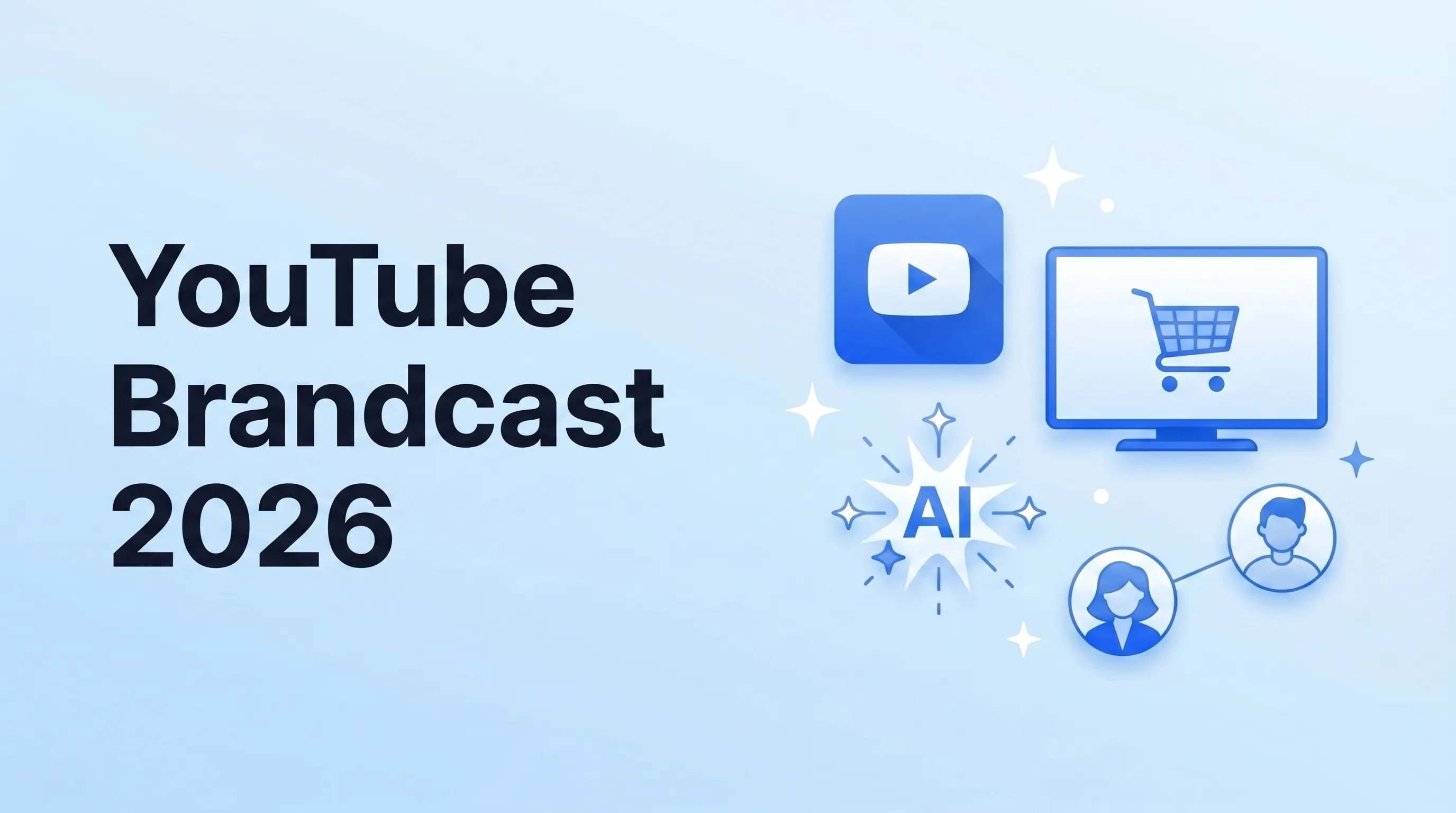
At Brandcast 2026, YouTube made the most aggressive pitch to advertisers since the platform was acquired by Google: connected-TV is now the dominant surface, AI is collapsing the creative production cycle to minutes, and the line between a viewer and a buyer has been compressed to two clicks. According to eMarketer's CTV ad spend tracker, advertisers are projected to push 60%+ of incremental brand budgets into connected-TV by end of 2026 — and YouTube wants every one of those dollars.
At Mark Studios we've shipped 10,000+ video projects, 5,000+ five-star reviews, and 200M+ views across creator channels and brand partnerships. The six announcements from Brandcast 2026 don't just change what brands can buy on YouTube — they change what a creator's packaging strategy needs to look like in 2027 to actually get monetized. Here's what landed, and what it means.
1. New Creator Shows — YouTube Becomes a Network
YouTube announced a new slate of Creator Shows from Kareem Rahma, Dude Perfect, Trevor Noah, Quen Blackwell, and others — premiering only on YouTube. This is the streaming-cable inversion completing itself: Netflix is trying to make creators look like studio shows, YouTube is letting creator shows look like premium TV but stay native.
For brands, the implication is sponsorship inventory you couldn't previously buy. Dude Perfect's audience was always available via the channel; what's new is structured, scheduled, multi-episode programming with brand integration slots that look more like network sponsorships than YouTube pre-rolls.
For creators, the implication is bigger: **YouTube is staking premium ad rates to a show format, not a video format.** Channels that publish individual videos compete on CTR. Channels that publish a recognizable show — recurring host, repeatable structure, episode numbering — get priced like cable. We've already pushed three creator clients in our roster toward episodic packaging for exactly this reason; the gap is widening between "videos that happen to be on a channel" and "shows that happen to live on YouTube."
2. Buy with Google Pay on TV — Shoppable Video Goes Mainstream
The headline feature, and the one with the longest tail: Buy with Google Pay now lets viewers complete purchases directly on their TV with just two clicks. For years, shoppable YouTube was theoretical on the living-room screen — viewers could see a product, but checkout meant pulling out a phone, opening Amazon, hunting the SKU.
That friction is now gone. Two clicks. On the remote. From an ad or a creator integration.
Implications:
- DTC brands suddenly have a true commercial channel on TV. DTC ad-spend research from Wyzowl consistently shows the biggest revenue killer in CTV advertising has been attribution gap — you couldn't tell if the spot drove a sale. Two-click TV checkout closes the loop.
- Creator product integrations stop being affiliate links and start being commerce surfaces. A creator demoing a product in a long-form video on a TV becomes, effectively, a QVC moment with a 2026 UX.
- Pricing power flips back toward the creator. Affiliate margins from Amazon Associates run 1–10%. Direct brand deals priced on conversion through Google Pay can move that to 10–25% per sale. The creators who set this up first will see margin improvements that compound over a calendar year.
3. Custom Sponsorships — AI Picks the Right Video for the Brief
Brands can now use Custom Sponsorships: AI dynamically surfaces videos tailored to a brand's desired moment. In practice, a brand briefs YouTube on the "moment" they want — a high-energy ad break, a tutorial moment, a quiet reflective passage — and YouTube's AI matches that moment across creator inventory.
The brand-side win is obvious: contextual targeting at scale, without doing manual creator outreach. The creator-side reality is harder: **the videos that perform best for Custom Sponsorships will be the videos that are clearly structured into moments.** Editor-paced content with distinct beats — open, problem, demo, transition, payoff — becomes more sellable than meandering long-form. This maps directly to the editing pacing principles we apply on every retainer.
If you're producing without an editor who can engineer those moments into the cut, you're leaving Custom Sponsorship inventory on the table starting now.
4. Masthead With Custom Content Shelf — Curated Brand Experiences
The YouTube Masthead was historically a single hero video at the top of the homepage. Now it lets advertisers curate an entire content shelf alongside the hero creative — multiple linked videos, a brand world inside one ad slot.
The strategic shift: brand storytelling on YouTube now expects a content ecosystem, not a single asset. A 30-second hero spot is the front door; the shelf below it is the rest of the brand. This is closer to how Apple launches a product page than how brands have historically run YouTube ads.
For creators in brand partnerships: this is where retainer relationships beat one-off integrations. A brand running a Masthead with content shelf needs 4–6 supporting videos. The brand will pay for those — but they'll go to whoever can deliver a system of videos that match the hero, not whoever sends the cheapest one-off.
5. Affiliate Partnerships Boost — Brands Can Amplify Organic Tagged Content
Affiliate Partnerships Boost lets brands amplify organic content that their products are already tagged in. Translation: if a creator organically tags Nike in a video, Nike can now spend ad dollars amplifying that creator's video as a paid promotion without needing a separate sponsorship deal.
This is a quiet game-changer for the creator-brand economy. Three downstream effects:
| What changes | Before Brandcast 2026 | After Brandcast 2026 |
|---|---|---|
| Creator product tags | Affiliate links, modest payouts | Same tags can attract paid amplification from brands |
| Brand discovery cost | Outreach + sponsorship deal | Find creators already talking, pay to boost |
| Creator earning power | Sponsorship + ad rev | Sponsorship + ad rev + boost revenue share |
Smart creators will start thoughtfully tagging products they actually use — not just because it earns affiliate revenue, but because each tag becomes a discovery surface for brands looking to spend amplification budget.
6. Multimodal Video Creation — Gemini, Nano Banana, Veo in the Brief-to-Final Pipeline
YouTube now ships Multimodal Video Creation tools using Google's latest AI models — Gemini, Nano Banana, and Veo — to move from creative brief to final production with just a few prompts.
We've integrated the same generative models into our internal production stack over the past quarter, and the honest read is:
- Brief-to-rough cut with AI: legitimately faster. What used to take a junior editor 4 hours for a 60-second ad rough now takes ~30 minutes.
- Brief-to-finished ad with AI alone: still not there. The polish layer — color grading, sound design, pacing decisions, brand consistency — is where AI-only outputs visibly fail. Wistia's 2026 production benchmarks and our own client comparisons both show AI-only finals underperform human-edited finals on completion rate by 18–30%.
So who actually wins from this?
- Brands with small budgets — they get a usable starting point in minutes, and bring in an editor for polish only. Total cost drops 40–60%.
- Creators with established style — they can prototype 5 thumbnail variants and 3 ad cuts in an afternoon and pick the strongest before committing editor time.
- Editors who refuse to integrate AI — they lose. The "AI-augmented editor" is the workflow that wins for the next 24 months.
The Pre-Brandcast Checklist for Brands and Creators
Before you treat any of these announcements as the immediate move, walk this list:
- Audit your channel for show-shape content. If a viewer can't tell episode 1 from episode 5, you don't have a show. Build a repeatable hook, structure, and outro.
- Set up product tagging on every relevant video. With Affiliate Partnerships Boost, tagging is now a revenue surface — not just a courtesy.
- Brief your editing partner on moment-tagging. Custom Sponsorships will price videos based on whether they have clearly identifiable structural moments. Make sure your editor is delivering that.
- Get a Buy with Google Pay test running. If you're a creator with product integrations, run a 30-day Buy with Google Pay test on one piece of content and benchmark conversion vs. affiliate links.
- Decide your AI policy. Are you using Veo/Gemini for ideation only, drafts, or full production? Set the line now — it's the same conversation every brand will be asking creators in 2026.
The biggest mistake we've seen brands make in past YouTube ad rollouts is treating new ad formats as "channel manager problems." These announcements are creative-team problems. Buy with Google Pay on TV is a thumbnail-and-pacing question. Custom Sponsorships is an editorial-structure question. Get the creative side of your team in the meetings about these now.
What We're Telling Our Roster
For our brand clients, our recommendation is straightforward: start budgeting against Masthead with Custom Content Shelf as a campaign spend in Q4 2026, not as a single buy. Plan 4–6 supporting videos that live as a content shelf, with the Masthead hero on top. Treat the AI tools as preview and rapid iteration only; deliver the final files through a human editor.
For our creator clients, three immediate moves:
- Restructure your most-recurring video format into a named show with episode numbers
- Audit your last 20 videos for product mentions and add tags retroactively where appropriate
- If you have a strong DTC product or affiliate partner, pilot Buy with Google Pay on the next two videos and measure
The brands and creators who treat Brandcast 2026 as a single big announcement are going to miss it. The ones who treat it as six distinct workflow shifts — one per feature — are going to compound the advantage for the next 18 months.
The Bottom Line
YouTube isn't trying to become TV. YouTube is trying to become the commerce-and-creator network that replaces TV. Brandcast 2026's six announcements are individually useful and collectively a strategic repositioning: connected-TV inventory, in-stream commerce, AI-accelerated creative, and a network-style format for creators. The brands and creators who plan for all six at once — not pick one — are the ones who'll see the next 24 months of ad-spend tailwinds.