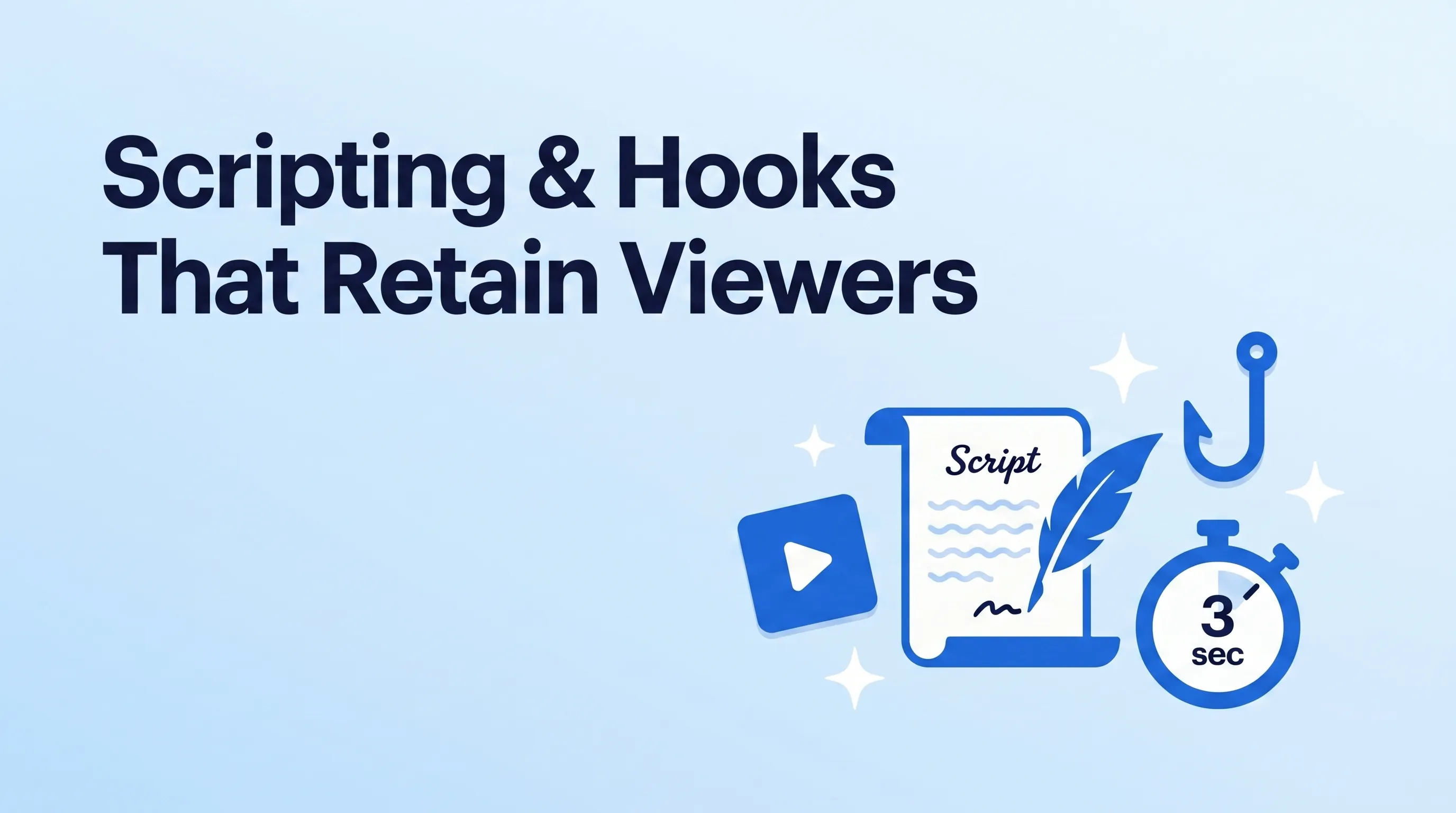
The Script Is 80% of the Video's Performance
You can edit a bad script into a watchable video, but you can't edit it into a winning one. After 10,000+ projects at Mark Studios, the single biggest variable that predicts a video's retention curve isn't the camera, the editor, or the thumbnail — it's the script.
This is the framework we use when we audit a creator's scripts or write them ourselves.
The 5-Part Video Script Structure
Every well-scripted video follows the same five parts. Skip any one and the retention curve breaks at that point.
Part 1 — The Cold Open (0:00–0:15)
The single most important 15 seconds of the video. Per YouTube's algorithm transparency disclosures, viewer behavior in the first 30 seconds determines 60–70% of whether the video gets pushed by the algorithm.
What works in 2026:
- The contradiction hook — "Everyone tells you to [common advice]. They're wrong. Here's why."
- The stat reveal hook — "97% of people who [activity] never [outcome]. The 3% who do, do this one thing."
- The visual hook — start in the middle of action ("Here's what happened when…") and pull back to context only after the viewer is committed
- The future-state hook — "By the end of this video, you'll be able to [specific outcome]."
What doesn't work:
- "Hi guys, welcome back to my channel" — instant scroll on YouTube and TikTok
- "Today I want to talk about" — same problem, gives no payoff
- "If you're new here, hit subscribe" — never lead with the ask
Part 2 — The Promise (0:15–0:45)
Once you've earned the click, set the expectation. What is the viewer going to learn / feel / get by the end? Specificity wins.
| Generic | Specific |
|---|---|
| "I'll show you how to grow on YouTube." | "I'll show you the exact 4-step framework I used to grow this channel from 0 to 100K subs in 9 months." |
| "I'll review the new iPhone." | "After 30 days of using only the iPhone 16 Pro for everything, here are the 5 things Apple got wrong and the 3 things they nailed." |
The promise should also implicitly answer "why should I keep watching?" If a viewer can't articulate that in their head by 0:45, they'll skip.
Part 3 — The Body (0:45 to ~80% of video length)
This is where you deliver the promise. Two structural principles:
Use micro-hooks every 60–90 seconds
Each section should end with a teaser for the next ("but the third one is actually the most important — here's why…"). TubeBuddy's retention research consistently shows videos with micro-hooks every 60–90 seconds retain 20–30% better than videos without.
Use the "open loop" pattern
Mention something interesting, then defer the explanation. The brain hates unresolved tension and forces continued attention.
Example: "I'll show you the framework that got us 1M subscribers… but first, you have to understand the one mistake I made that almost killed the channel."
The viewer now has TWO reasons to keep watching: the framework AND the mistake.
Part 4 — The Climax / Reveal (~80% mark)
The single biggest payoff moment. The frameworks's full reveal, the "and here's the result" moment, the answer to the cold-open question. This should be obviously worth waiting for.
If your video doesn't have a clear climax moment, the script structure is broken — viewers won't know when to feel rewarded for staying.
Part 5 — The CTA + Outro (last 20 seconds)
The CTA goes here, not at the start. Before the CTA, deliver a final value-add: a "here's what to do next" or "if you found this useful, here's the one thing to remember."
CTA structure that works:
- "If you got value from this, subscribe — I post one of these every week."
- "Watch this next video for the deeper dive on [related topic]." (drives session watch-time)
- "Drop a comment with [specific question]." (drives engagement signals)
Don't stack multiple CTAs. Pick the one that matters most for this video.
Hook Templates That Have Worked Across Hundreds of Videos
Pattern-matched from videos we've shipped that hit 50%+ APV:
| Hook template | Example |
|---|---|
| The "everyone is wrong" hook | "Most YouTubers tell you to upload daily. They're wrong. Here's the data." |
| The "secret stat" hook | "Channels under 10K subs have a 73% lower CTR than channels above 10K. Here's why — and how to fix it." |
| The "transformation reveal" hook | "Six months ago this channel had 200 subs. Today it has 100K. Here's the exact 4-step playbook." |
| The "rare admission" hook | "I'm going to share something my agency clients pay $5,000 to learn." |
| The "specific deadline" hook | "Before YouTube changes the algorithm in October, you need to know this." |
| The "you vs. them" hook | "If you're a creator under 50K subs and you're competing with mega-channels, here's the one structural advantage you have." |
The 7th hook that's overused and fatigued in 2026 is the "you won't believe what happened" hook. Audiences pattern-match it as clickbait and skip.
Scripting Tools That Save Hours
| Tool | Use for | Cost |
|---|---|---|
| Descript | Outline + write + record + edit in one tool | $12–$30/mo |
| ChatGPT / Claude | Brainstorm hooks, expand outlines, polish drafts | $20/mo |
| Notion | Script template + version control | Free–$10/mo |
| Hemingway Editor | Cut sentence length + clarity check | Free |
| TubeBuddy keyword tools | Validate script topic against search demand | Free–$31/mo |
We use Descript for the rough script + record + first cut, then move to Premiere for polish. Descript's "edit by editing the transcript" feature is the single biggest time-saver in our scripting workflow.
The 6-Question Pre-Recording Checklist
Before you hit record on any video, run this gate:
- ✅ Can I summarize the cold open in one sentence?
- ✅ Is the promise specific enough that a viewer knows what they'll get?
- ✅ Are there micro-hooks every 60–90 seconds in the outline?
- ✅ Is there a clear climax / reveal moment?
- ✅ Is there exactly ONE CTA, not three?
- ✅ Have I read the script aloud to check pacing? (Reading aloud catches awkward phrasing 5× faster than reading silently.)
If any of these is "no," fix it before filming. Re-shoots are 10× the cost of script edits.
Common Script Mistakes That Tank Videos
What we see when we audit underperforming scripts:
- Backstory before payoff. "Let me first explain how I got into this…" — viewers don't care about your origin story until you've earned 5 minutes of trust.
- Buried lede. The most interesting moment of the video happens at 8:32, not 0:30. Pull it forward.
- No specificity. "Various creators" → "MrBeast and Marques Brownlee specifically." Specifics buy credibility.
- Run-on segments. A 4-minute monologue with no visual or topical break. Reset every 60–90 seconds.
- Asking for the subscribe at 0:30. Viewers haven't earned trust yet. Move to the end.
- Outro that's longer than the climax. Your final point should be the climax, not the CTA.
The Bottom Line
Scripts are the highest-leverage 90 minutes you can spend on a video. A great script saves the editor hours, retains viewers longer, and gives the algorithm signals that compound. The five-part structure + micro-hooks + open loops is what every consistently-growing creator's videos quietly use, even when they don't talk about it that way.
If you want our team to script your videos — full ghost-writing, hook-only doctoring, or in-line script doctoring on your own drafts — we offer scripting as a stand-alone service alongside our editing work.