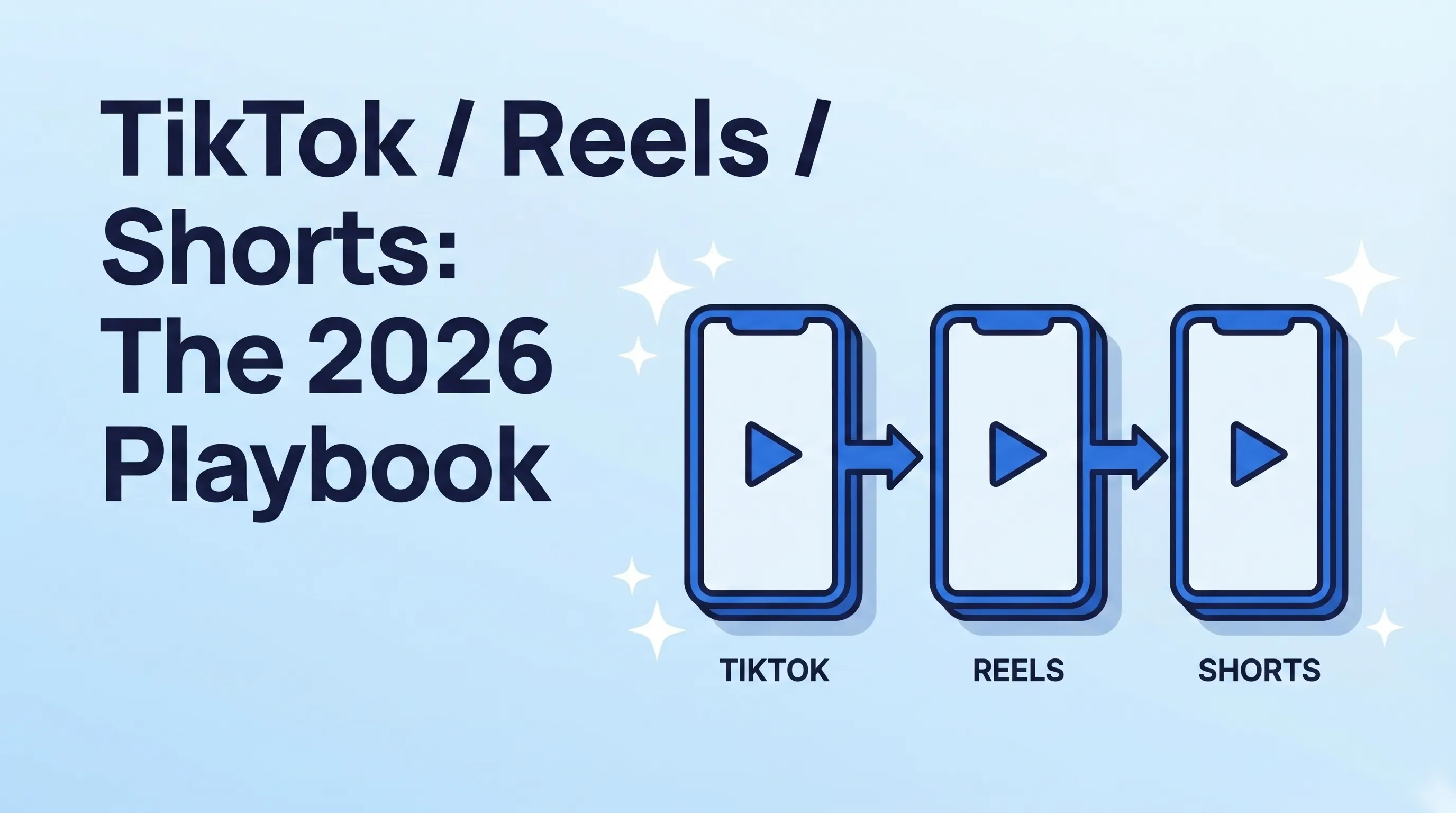
Three Platforms, Three Different Cultures
The instinct most creators have is to film one vertical video and cross-post it everywhere. The instinct is wrong.
YouTube Shorts (averaging 200 billion daily views), TikTok (~1.5 billion monthly active users per DataReportal), and Instagram Reels each have a different audience, different algorithm, and different aesthetic. A video that hits 1M views on TikTok will often flop on Shorts — not because the content is bad, but because the cultural fit is off.
At Mark Studios we produce short-form for hundreds of channels. Here's what actually works on each platform in 2026.
TikTok: Native, Raw, Trend-Driven
What wins: sound-driven trends, low-production raw aesthetic, "POV" and "reaction" formats, fast cuts, big text overlays.
Algorithm signals:
- Watch-completion rate is the dominant signal. TikTok's Creator Code documentation confirms videos that hit ≥80% completion get the biggest push.
- Re-watches and shares carry 3–5× the weight of likes.
- Comment depth — long reply chains in the first 24 hours signal the video is conversation-worthy.
Editing rules:
- Use a trending audio within 7 days of it peaking. TikTok actively boosts videos using rising sounds — per Marketing Brew's analysis of the FYP, this is the single biggest "free reach" lever.
- Hook in 1–2 seconds, not 3. TikTok viewers swipe faster than YouTube viewers.
- Captions burned in to the video, not native CC. TikTok's native captions are inconsistently displayed.
- Vertical 9:16, 1080×1920, 30fps. Higher framerates get re-encoded weirdly.
Instagram Reels: Polished, Aesthetic, Aspirational
What wins: clean aesthetics, "lifestyle" framing, aspirational visuals, music-driven cuts, polished motion graphics, B-roll-heavy.
Algorithm signals:
- Sends (DM forwards) are the strongest single signal in Reels. Adam Mosseri has stated this publicly repeatedly. A reel with 500 saves and 50 sends is weaker than one with 50 saves and 200 sends.
- Profile visits driven by the reel — Instagram pushes reels that drive profile traffic because that's what monetizes for them.
- Time-on-content including loops.
Editing rules:
- Higher production value than TikTok. Reels viewers expect polish. Color-grade. Use stabilization. Premium sound.
- Music selection matters more than trend-jacking. Reels rewards music that fits the brand aesthetic, not just whatever's trending.
- Hook with motion, not faces. Reels viewers respond to dynamic B-roll opens better than talking-head opens.
- 3–5 second loops at the end (last frame matches first frame) double watch time because the reel auto-loops.
YouTube Shorts: Long-Tail, Topic-Driven, Cross-Format
What wins: topic-led content, educational/informational, hooks that promise specific value, less trend-driven, more evergreen.
Algorithm signals:
- Subscriber conversion is heavily weighted in Shorts because YouTube wants Shorts to feed long-form viewership. A short that drives subscribes gets pushed harder.
- Watch-time on subsequent videos — if your Short leads viewers to your long-form, the algorithm rewards future Shorts.
- Likes-per-impression carries more weight on Shorts than the other platforms.
Editing rules:
- Title in the description matters more than on TikTok/Reels. Shorts surfaces in YouTube search; titles drive long-tail traffic.
- Promote your long-form in the first comment or the description. Shorts is a top-of-funnel for your channel.
- Don't over-edit. Shorts viewers respond to clarity over flash. The most-watched Shorts are often single-shot videos with clear narration.
- Use YouTube's native Shorts remix feature to create from your own long-form catalog.
The Cross-Posting Rules
Short answer: don't cross-post identical videos. Long answer:
- TikTok-native first, repurpose elsewhere. TikTok detects watermarks and downranks them aggressively. If you film for TikTok and download from TikTok, Reels and Shorts will demote that video.
- Strip watermarks before reposting. Tools like SnapTik or Submagic export clean versions.
- Reframe per platform. TikTok captions sit lower; Reels captions sit higher (Instagram UI covers the bottom). Re-position text per platform.
- Different hooks per platform. TikTok's hook can be raw and casual; Reels's needs to be visually polished; Shorts's needs to promise specific informational value.
The 80/20 Rule for Multi-Platform Creators
If you have to pick — pick one platform and dominate it before going multi-platform. The math:
- A creator with 100K followers on one platform beats a creator with 30K on three platforms — every time. Brand deals, monetization, and audience compounding all reward concentration.
- Multi-platform makes sense after 100K on your primary platform. Below that, you're spreading thin and losing the algorithmic compounding.
We see this pattern across our client roster: the channels that grow from 0 to 1M did so on one primary platform first.
Production Workflow That Actually Scales
Here's the workflow our team runs for clients producing 10–20 short-form videos per week across all three platforms:
- Film vertical native. One filming session, raw 9:16 footage.
- Edit a master TikTok cut first — full trend-aware, native style.
- Re-cut for Reels — slower pacing, polish color grade, swap audio for music-fit.
- Re-cut for Shorts — strip overt TikTok markers, add long-form CTA, reframe captions.
- Schedule with native upload on each platform, not a cross-poster (cross-posters add metadata that signals "automated").
- Track per-platform metrics weekly — watch-completion (TikTok), sends (Reels), subscribers (Shorts).
This is 3× the editing work of cross-posting, but the views are usually 5–10× higher because each platform actually surfaces the content.
The Bottom Line
Short-form in 2026 isn't one channel — it's three channels with different rules. Treating them the same is the #1 reason creators feel like "short-form doesn't work for me."
If you want our team to handle short-form production at scale, we typically run multi-platform pipelines for $2K–$8K per month depending on volume.