Why Video Podcasts Win in 2026
In 2025 Spotify confirmed video podcasts now outpace audio-only podcasts in growth, and YouTube is consistently the #1 platform podcast listeners use to discover shows. Audio-only podcasting still works, but if you're starting in 2026 and not filming, you're leaving 2× the audience growth on the table.
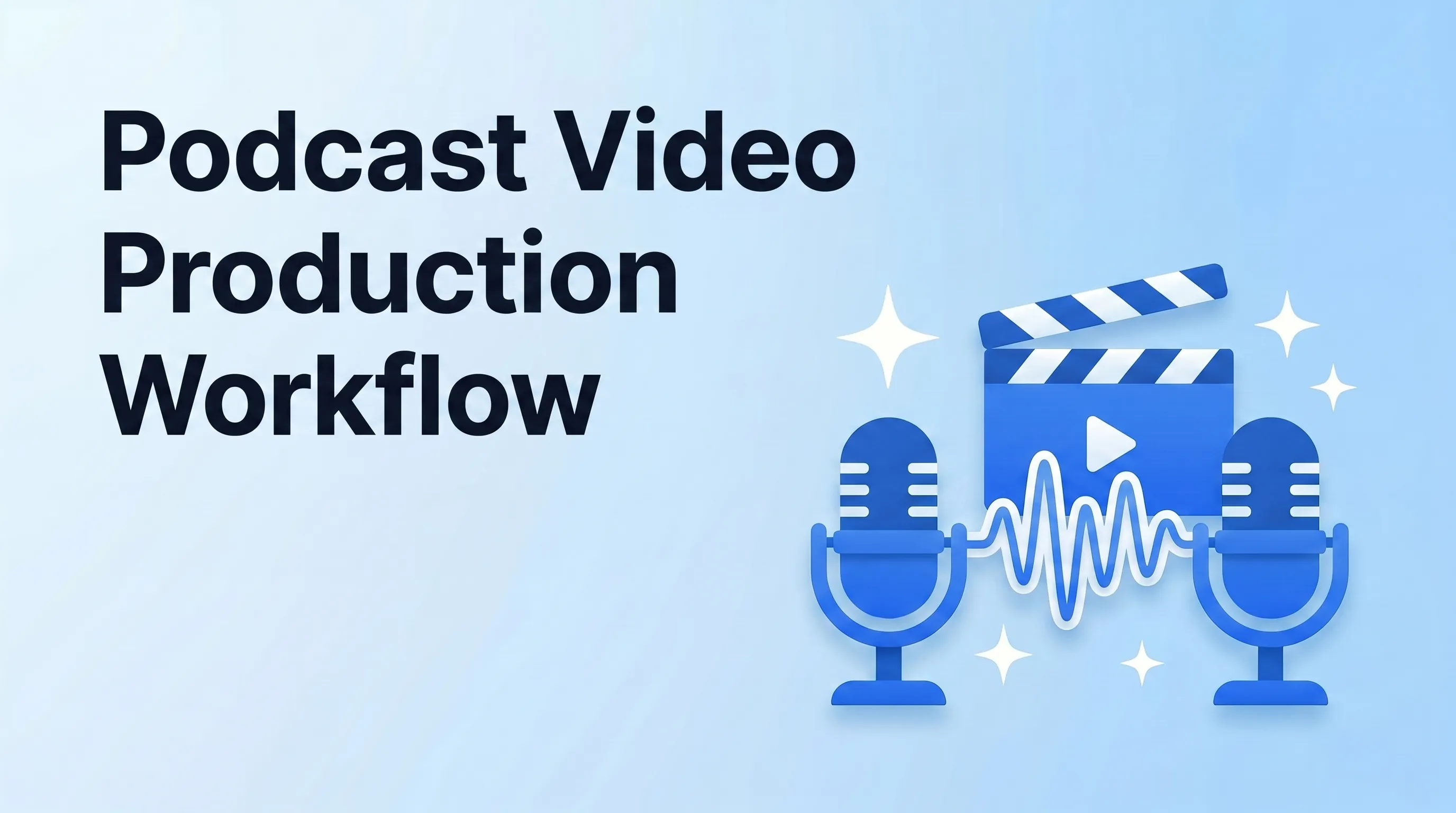
We produce video for several podcast clients at Mark Studios — talking-head interview shows, panel formats, and remote-recorded video. Here's the production workflow that actually scales.
The Three Camera Positions That Cover 95% of Shots
For a 2-host podcast, you need a minimum of three camera angles. With these three, the editor has every shot they need without filming "for safety."
| Camera | Position | Lens | Purpose |
|---|---|---|---|
| Cam A | Wide on host 1 | 35mm or 50mm | Tight chest-up of host 1 |
| Cam B | Wide on host 2 | 35mm or 50mm | Tight chest-up of host 2 |
| Cam C | Wide 2-shot | 24mm or 28mm | Both hosts in frame, "establish" + lifesaver |
A 4-camera setup adds Cam D — a high or side angle — but C is the lifesaver-shot for any 2-host show.
For solo or interview podcasts with a remote guest, you only need 2 angles in-room (host A wide + host A close) plus the remote feed.
The Equipment Stack at Each Tier
Solo Host Podcast (~$1,500 total)
| Component | Recommended | Cost |
|---|---|---|
| Camera | Sony ZV-E10 + Sigma 16mm f/1.4 | $700 + $400 |
| Mic | Shure SM7B + Cloudlifter CL-1 | $400 + $150 |
| Audio interface | Focusrite Scarlett Solo 4th gen | $130 |
| Lighting | Aputure Amaran 60d + softbox | $250 |
| Recording | OBS Studio (free) | Free |
Two-Host In-Studio (~$5,000 total)
Add a second camera + lens setup ($1,100), a second SM7B + Cloudlifter ($550), upgrade to Rødecaster Pro II ($699) for multi-mic mixing with auto-leveling, plus AutoPod ($30/mo) for AI-driven multi-cam editing.
Studio-grade Multi-Cam (~$15,000+)
Three Sony FX3 cameras with 35mm primes, Blackmagic ATEM Mini Extreme ISO for live switching with isolated per-camera recording, four Shure SM7B mics, Universal Audio Apollo Twin X, Aputure 300X LED panel set, plus a teleprompter and acoustic treatment for the room.
This tier is overkill for most shows but standard for top podcasts (Joe Rogan-tier, Lex Fridman-tier).
The Recording Workflow
Pre-recording (15 minutes)
- Cameras white-balanced and exposure-locked. Auto-WB drift mid-recording is the #1 amateur tell.
- Mics tested at speaking volume. Set gain so peaks hit -12 dB, never above -6 dB.
- Headphones on every host. You should hear yourself + the room mix back.
- Clapboard or smart-slate at start. Records a single visual+audio sync point so the editor doesn't have to align manually.
- Phones on Do Not Disturb. Cell radios cause audio interference.
During recording
- Each camera records its own clean ISO file locally (4K H.265 to internal SD card)
- Each mic records its own ISO track (multi-track WAV via Rødecaster or interface)
- Backup: a separate audio recorder (Zoom H6 or similar) catches the room mic as insurance
- Don't switch cameras live — record everything, switch in post
Post-recording sync workflow
The single biggest time-sink in podcast video is camera + audio sync. We use PluralEyes or DaVinci Resolve's auto-sync feature — drop all camera files + audio files into a sync bin and Resolve aligns them via waveform match in 30 seconds.
Multi-Cam Editing With AutoPod
AutoPod is the single tool that turned podcast video editing from a 6-hour task into a 1-hour task at Mark Studios. It auto-cuts multi-camera footage based on who's speaking — so when host A talks, the cut shows Cam A; when host B talks, it cuts to Cam B; when both talk over each other, it cuts to the wide.
The workflow:
- Import synced multi-cam sequence into Premiere Pro (Resolve has its own equivalent feature)
- Run AutoPod on the sequence
- AutoPod outputs a cuts list based on speaker-detected audio
- Editor reviews and adjusts the 5–10% AutoPod gets wrong
- Polish, color-grade, deliver
Without AutoPod, a 90-minute interview takes ~6 hours of multi-cam editing. With AutoPod, it takes ~90 minutes. We've shipped hundreds of hours of podcast content using this exact workflow.
Audio Is Still 70% of the Show
Visual matters, but audio is what determines whether listeners stay. Audio rules from our podcast clients:
- Each host on their own track. Never share a mic.
- Heavy compression (3:1, fast attack, -16 dB threshold) on each voice — keeps levels even when one host gets quiet or shouts.
- EQ each voice individually — a deep voice needs different treatment than a higher-pitched voice. Generic "podcast EQ" presets are a starting point, not a destination.
- Side-chain music to ducks under voices automatically.
- Loudness target: -16 LUFS for podcast video (slightly louder than YouTube's -14 because podcast players bake in less compression).
Visual Polish That Distinguishes a Pro Show
Three small details we add to every podcast video that DIY shows skip:
- Lower-third name tags for each speaker, animated in for first 3 seconds when each speaks initially. Makes the show watchable for first-time viewers who don't know the hosts.
- Episode title on a section card at the cold open. Acts like a chapter title — looks broadcast-grade.
- Branded outro card with channel info, "subscribe / follow" CTA, and next episode link.
These three additions take 20 minutes per episode and elevate the show 30% in perceived production value.
Distribution: One Recording, Five Outputs
The single recording session should produce:
- Long-form YouTube video (16:9, full episode) — main hero asset
- Audio-only podcast (MP3, 192kbps, in Apple/Spotify/Overcast) — extracted from the master
- 8–10 short-form clips (9:16) for TikTok / Reels / YouTube Shorts — see our repurposing playbook for the full system
- Transcript blog post — the audio runs through Whisper and outputs a SEO-optimized text version
- Newsletter excerpt — top 3 quotes turned into a weekly email
This 1-to-5 multiplier is why podcast video is so high-leverage. One 90-minute recording = 5 distinct content assets.
The Bottom Line
Video podcasts in 2026 win on YouTube discoverability + Spotify's video push + cross-platform repurposing leverage. The production workflow is solvable with off-the-shelf tools — AutoPod for editing, Rødecaster Pro II for audio, OBS or ATEM for capture.
If you want our team to handle video podcast production end-to-end, we run weekly podcast pipelines for several creators in the $1,500–$5,000/month range depending on episode length and polish tier.